When a private difference is made public by one party, one wonders just what is going on. Coco heard about this one and came up with his own response, which follows below. In some ways it seemed to him that the public remarks were either attention seeking, or simply stirring up of trouble for a colleague, with whom their had been a cordial relationship for at least none years. What had gone wrong?
Well, the answer lies not in the article itself, but in something two steps removed. The protagonist, to whom Coco replies, had written together with some others to the defendant, who had replied in a similar vein. That may be understood from the text of the public article. Neither of these two letters are in the public domain, though Coco has had sight of one of them.
This article then falls into presently two parts, Coco’s response and the public article. Should the earlier documents become public, they will be added here in due course to complete the picture, but if Coco forgets to do so, please remind him. So take a deep breath, and remember to breath as you read.
Is the patient really at the centre?
Resilia is a patient organisation in Italy. Whilst the writer has only recently heard of them, he understands that their reputation is of a high standing in Italy. Their website indicates the breadth of the work that they do with patients who live with lymphœdema in Italy.
We read there: Linfa per la vita. It does not translate well into English. AI tools have some way to go, in the face of all the hype about them, before they equal the quality of imagination of the human brain. Whilst the translation is in part helpful, anyone with the beginnings of an understanding of lymphœdema will recognise the difference, and some overlap, in function of lymph fluids and the sap of a plant.
It is L’associazione per le persone affette da Linfedema. Whilst there are three, at least, other similar organisations in Italy that they are the association, not merely an association, indicates the strength of their applaudable ambition to be able to deliver to patients all that they need to improve their quality of life whilst living with lymphœdema. As it says on its web-site it è un’associazione impegnata al fianco delle persone affette da linfedema, delle loro famiglie e di tutti coloro che operano nella prevenzione, nella diagnosi e nel trattamento di questa patologia. This translates well into English on its web-site – https://www.associazioneresilia.it/chi-siamo/
The International Lymphoedema Framework (ILF) shares the vision of Resilia for patients. Established independently in 2009, but operating since 2002, it has become the leading scientific organisation for the promotion of health care and understanding in the world of lymphœdema. The motto underlying the work of ILF expresses this as Creating a better everyday life for people living with lymphoedema and related disorders. This object is further expanded in the fundamentals of the ILF, in its goals and beliefs – see https://www.lympho.org/about in the ILF web-site. One of the fundamentals of ILF is that Patients should always be at the heart of the Framework Projects and it is here that the article referenced commences.
At a first reading it may appear to be a sharp criticism of the conference planned in partnership with the Italian Lymphedema Framework (ITALF) which will take place in Rome at the end of October this year, but a more careful reading will expose that this is not so.
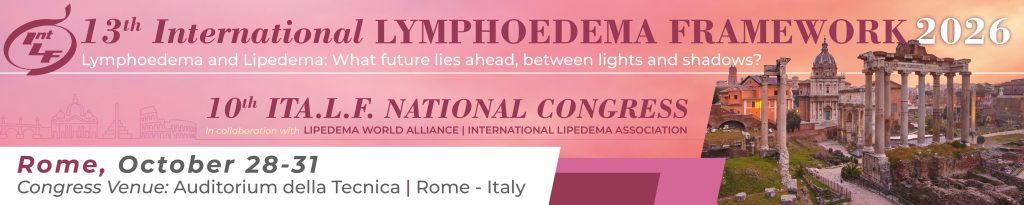
The organisers of conference face many hurdles. They may be divided into several areas – you, dear Reader, may identify among others:
• Audience
• Finance
• Logistics
• Speakers
Above these we have the purpose and outcome. We have to ask what do we want to achieve by the conference; what will be the outcome? This object is subservient to the overall objects of the organisers of the conference. For the ILF this is expressed in its motto Creating a better everyday life for people living with lymphoedema and related disorders. If what we do at the conference, however it is done, will not serve that purpose, then we might as well pack our bags to live in isolation on an unmapped island in the middle of the ocean.
The purpose and expected outcomes speak towards the necessary composition of the audience, and the determination of the selection of appropriate speakers.
Finance and logistics play their part by imposing limits on both the composition and the size of the audience, and the selection of speakers to address the messages that the organisers wish to get across.
In an ideal world with unlimited resources it might be thought that we should bring together all patients, professionals and carers but would that achieve the objective? It may help the patients for one, two or three days, but what then? Likewise, we may have a specialised clinic, in which one nurse is outstanding. The patients delight in her manner, but even more so in the way she applies compression. It always works; there is no pain; the œdema flows away. If she is not on the shift, some patients look in and walk away to return later. One day the clinic is devastated. She is leaving. What will they do? She explains: I am going to teach others how to do it. If I stay here I can treat you, but then I am gone, but if I teach a dozen each year, there will be a gross to treat you after I have gone.
We do not live in an ideal world. We live in a world full of suffering, sickness, disease and dying. If we lived in an ideal world there would be no cancer, no lymphœdema, no sickness, no death. The best professionals must still stand in line for treatment when they need it. But if we teach and train the best professionals, who will be able, and are willing, to teach others then we shall be able to promote our goal of Creating a better everyday life for people living with lymphoedema and related disorders for each one of those professionals will go out better equipped to serve the patients who they have been called to serve.
Il paziente al centro deve poter esserci
That is rather a long introduction, but let us turn to what the article actually says. It is most helpful to look at the conclusion first for it raises some very important and significant issues. There are three questions:
• Una questione di politica sanitaria
• Una questione culturale
• Una questione di equità e partecipazione
That is health policy; culture; and equity and participation.
Health Policy
How can we influence health policy? The National Frameworks work together to lobby government for change. In some countries treatment, whilst available, is not available on the health tariff. In others it is not available at all. Who is to blame for that? Is it the government? Is it that there are no professionals who wish to work in the field? Is it that there are no advocates for the patients?
To influence health policy is a long term project. It requires grit and determination. It took Heather Ferguson ten years- Youtube – to achieve a change to health policy in the United States of America. On the other hand there are a few remarkable cases of rapid change by an accidental meeting or personal experience at a high level. Someone speaks with another family member about her treatment. The other family member remembers a similar description had been in a document which had passed over her desk a year before. She goes back to the office, and examines it. It was a funding application. The application now moves forward. Such exceptional cases are exceptional. The hard work must be done.
Culture
Culture can be the bane of our lives, can it not? How am I expected to behave in this place? Am I allowed to cross my legs, even at the ankles, or not? How do I use chop-sticks (a question for occidentals)? Is it the same way in China, Japan and Taiwan? How do I use a knife and fork (a question for orientals)? It is not the same in Europe and in North America. There are more difficult questions about the way we speak. When an opinion is offered, do we say: That’s not right! and expect a robust response demonstrating that it is right; or do we say: Let us explore that and follow up with a request that demands further demonstration of its rightness?
Anyone who has been to Uganda will understand that lymphœdema, in its filariasitic form at least, is caused by a curse. Well it is, but they do not mean by it what we know in the West it means. The sufferer has been cursed by a neighbour or an enemy, perhaps in response to some supposed offence or merely out of caprice. Healing can only be obtained by a lifting of the curse. Such thinking is embedded in animistic, shamanic cultures. We have to overcome (overturn – but don’t let the social anthropologist hear you use that word) such thinking in order to deliver effective treatment.
In the West we have a culture which almost says: The doctor can fix it and in some countries we add and fix it for free. In other cultures there is an acceptance, either because there is no health care or even basic healthcare is unaffordable.
So then, how do we approach different cultures? This is a matter which perhaps is largely ignored, but should be addressed.
Equity and participation
There is a sense in which if we could get over the first two points that this one would fall away. IF health policy, culture and the needs of the population were perfectly aligned then there would be equity and participation. We do not however live in such an ideal world, and so the question of equity and participation do arise. The world is not fair. Resources are scarce and not shared equally.
We cannot run away from this. It must be addressed.
So in summary, we recognise that Resilia has raised that need to be addressed and the proper forum for that must be found. Resilia have indicated that there shall be further reflections in the coming days and that Lo farà con domande, qualche provocazione e anche un po’ di ironia. We hope that as well as the irony, there shall be further exposition of the matters raised here, perhaps even setting out a framework in which discussion and resolution may be found.
We agree on the importance of this. If the patient is to be at the heart of the work, he must be there.
Se il congresso costa, cerchiamo insieme chi può sostenerlo
Finance is one of the constraints that is imposed upon us. It affects us individually – not everyone can afford to buy a new luxury yacht every year, and employ the crew to sail it – nationally – consider the disparity of health services between one nation and another – and at every level in between.
Money is always difficult to talk about, but we must consider how the conferences are financed. Presently we look for sponsorship from industry, partners and attendance fees. We are constrained by what each contributor can afford.
Industry and other funding bodies are also constrained by their own masters’ allocation of funding. It may be easier in one year to obtain funding than another, because the partner is focussing on a different area of their own business. A partner seeking to expand its market in say Taiwan, may be more amenable to support a conference there than they would if we held one in Korea, say?
We then have to look at the other side. Knowing, or at least having an idea of what is available we have to plane the conference within that budget. Can we afford, assuming it were available, the Colosseum or do we need to look for something a little more modest, perhaps the Stadio Olimpico? Knowing the venue then, logistics comes into play and we plan space for the supporters, the exhibition area, and for the audience and speakers.
And to answer their question: We do believe it is important for patients to participate, so possiamo cercare un modo perché il costo della loro partecipazione non ricada proprio su di loro? This section strongly suggests that there is a way that could be found. After many years of struggling with funding, we are sure that we and ITALF would take on board whatever proposals Resilia may have in this regard.
Esistono pazienti più portati di altri?
The question about patient understanding, implying I think here a fitness to attend the conference, is difficult. We do believe that there are no first and second class patients, but we are, and Resilia, being a patient organisation, also must be, aware that not all patients are the same. How can we classify them? They are all human beings created equal in the words of the Declaration of Independence, which some honour this year.
But we must be realistic. There a vocal patients and there are quiet patients. There are patients who a grateful for whatever treatment they are given, and there are patients who complain even when they have the gold standard treatment. There are patients who understand compression and lymph drainage but still remove their compression. There are patients who have little understanding of lymph drainage, but put up with the compression even when it itches. There are patients who can show other patients how to bandage, and there are others who never seem to get it. This is not to say we classify them. Each one is different, but is to be treated as best as possible having regard in our relationships with them to their different levels of understanding and their values. We must also bring into our thinking that having the same, equal, opportunities does not necessarily lead to the same, equal, outcomes.
The organisers of the conference have offered each patient organisation in Italy eleven free places for the conferences. One of those places is for the president (by whatever title the organisation identifies him) of the organisation, the other ten are for patients chosen by the organisation. Five patient groups wrote to ITALF about this, and there are three more patient groups who benefit from this allocation, giving a total of eighty-eight free places for participating patients out of a capacity of six to seven hundred. How the organisation allocates the places offered is entirely up the itself. Resilia decides how to allocate the places.
There are many different way in which such an allocation could be made to the patients
• who will most benefit,
• who will provide the greatest benefit to the work of Resilia
• who enter a ballot and are selected
• etc
They could also themselves seek sponsorship for their members to attend and use the ten allocated places to reduce the amount of sponsorship required, thus making available the same opportunities for their members.
If they are going to ask about benefit, then they need to think carefully, compassionately and objectively about individuals. One patient may think, and make a lot of noise about it, he may benefit greatly by attendance, but you know he will not listen to anyone, and continue to complain as he does with you; whereas another will go, sit quietly listening, taking in every word, then come back to tell you about it, and ask about the things she did not understand. Who will benefit the most? Perhaps also ask, how much will it benefit other patients if the second patient goes?
We put the patient at the heart of all we do. If we send the first patient to the conference, he may be at the centre, but no one else it. If we send the second patient, every other patient with whom she comes into contact is placed at the centre, for the will all benefit from what she has learned.
Non è solo una questione di 300 euro
So we are left in agreement with all that our good friends at Resilia have said. This is not just a matter of €300. They have raised questions which affect us all, not just the 2026 conference, and to which we presently do not have all of the answers. Every organisation which supports people living with lymphœdema, every professional, every carer, faces such questions perhaps not on a daily basis, but regularly in all that they do. Where do our resources come from, and how do we allocate them? Resilia has a membership fee of €25pa, ITALF likewise a patient fee of €15pa.
Care, compassion, objectivity, common sense all come into the answer to the question where?, and we work in the best possible way to keep patients at the centre despite the financial and logistical constraints imposed by our circumstances. Even if we could afford the Stadio Olimpico, is it not doubtful that we would have room enough there?
We provide what we can within our powers. We want patients to be at the heart of what we do, that is the Framework Projects. This is achieved by doing what we can towards Creating a better everyday life for people living with lymphoedema and related disorders. We work with patients, their organisations, professionals, carers, institutions, industry, other partners and governments to seek to achieve this.
One of the most effective ways is the dissemination of knowledge and understanding. If we give one professional, who has five hundred patients, a better idea of what better treatment is, we create a better life for five hundred people living with lymphœdema. Let us then, each one of us, do what we can, in our sphere of influence to enhance the lives of these individuals. We may never have contact with any one of them, but if someone mentions lymphœdema, or problems after cancer, ask the question: Have looked at the web-sites of ILF, ITALF, Resilia or the many other organisations who work in this field. ILF is a good place to start, then the National Frameworks to find out what is going on in a particular country.
The writer apologises for using the word patient to describe people living with lymphœdema. The full description would irritate many a reader, whilst the initials PLWL may be an acronym in Welsh are unpronouncable for an English speaking reader. In any event the initials in Welsh would be PSBGL (Pobl sy’n byw gyda lymffoedema), so we have no acronym at all.
Appendix I
Original article in Italian and English from Resilia (un’associazione per le persone affette da linfedema – an association for people affected by lymphedema)
Il paziente è davvero al centro?
16 Set 2026
Il paziente è davvero al centro?
Quando partecipare diventa una questione di accesso
Trecento euro.
Potrebbe sembrare semplicemente il costo di iscrizione a un congresso scientifico.
Ma quando quel congresso parla di una patologia cronica e tra le persone chiamate a pagare ci sono proprio coloro che con quella patologia convivono ogni giorno, quei 300 euro smettono di essere soltanto una quota di partecipazione.
Diventano una domanda.
Che cosa significa davvero mettere il paziente al centro?
Una richiesta nata dalle associazioni dei pazienti
In vista del Congresso internazionale dell’International Lymphoedema Framework, associato al Congresso nazionale ITALF, in programma a Roma dal 28 al 31 ottobre 2026, Resilia ETS e altre quattro associazioni impegnate nella tutela delle persone con linfedema hanno presentato una richiesta precisa.
Non è stata chiesta la gratuità di viaggi, pernottamenti, pasti o altri servizi.
È stato chiesto che i soci delle associazioni di pazienti potessero accedere gratuitamente ai lavori congressuali e all’area espositiva.
Una richiesta nata dalla convinzione che partecipare ai luoghi nei quali si discute di ricerca, cura, assistenza e futuro di una patologia non possa essere considerato un semplice servizio accessorio per chi quella patologia la vive ogni giorno.
La risposta e il problema che rimane
Nella risposta ricevuta, l’organizzazione ha illustrato le difficoltà e i costi legati a un congresso internazionale, dalla capienza della struttura alla sicurezza, dai servizi tecnici alla traduzione simultanea.
Sono state inoltre previste alcune possibilità di partecipazione gratuita: l’incontro dedicato a pazienti e associazioni del 28 ottobre, l’accesso integrale per alcuni rappresentanti e un numero contingentato di iscrizioni gratuite in determinate condizioni.
Comprendiamo che organizzare un evento scientifico di queste dimensioni abbia un costo.
Ma la questione che abbiamo posto non scompare.
Anzi, diventa ancora più evidente.
Non è solo una questione di 300 euro
Il punto non è stabilire se 300 euro siano tanti o pochi in assoluto.
Il punto è chiedersi quale posto vogliamo riconoscere al paziente.
Se il paziente è soltanto il destinatario finale della conoscenza scientifica, allora possiamo considerarlo semplicemente un partecipante a un evento.
Ma se parliamo di patient engagement, di partecipazione, di ascolto e di centralità della persona, allora il suo ruolo cambia.
Il paziente non è soltanto qualcuno di cui si parla.
È qualcuno con cui parlare.
È portatore di esperienza, bisogni, domande e conoscenza della propria quotidianità.
Ed è proprio su questa differenza che le associazioni hanno richiamato l’attenzione nella loro risposta: informare un paziente non significa necessariamente coinvolgerlo nei processi che lo riguardano.
Esistono pazienti più portati di altri?
Nella risposta ufficiale compare anche un’espressione che ci ha fatto riflettere: la possibilità che partecipino alcuni pazienti considerati “più portati” a questo tipo di relazione.
Ed è qui che la questione diventa anche culturale.
Che cosa significa essere un paziente “più portato”?
Chi stabilisce chi possiede le caratteristiche giuste per partecipare?
E soprattutto: può l’accesso alla conoscenza dipendere dalla disponibilità economica, da una selezione numerica o dalla capacità di qualcuno di rientrare tra i pazienti considerati più adatti?
Per Resilia la risposta parte da un principio semplice.
Non esistono pazienti di serie A e pazienti di serie B.
Esistono persone che convivono con una patologia e che dovrebbero avere, per quanto possibile, le stesse opportunità di conoscere, comprendere, partecipare e far sentire la propria voce.
Se il congresso costa, cerchiamo insieme chi può sostenerlo
Riconoscere che un congresso internazionale abbia costi importanti non significa necessariamente che tali costi debbano ricadere sui pazienti.
Se si considera davvero strategica la loro partecipazione, crediamo sia possibile cercare insieme forme alternative di sostegno: istituzioni, fondazioni, enti, sponsor e aziende che operano nei settori legati alla cura, ai dispositivi e ai servizi per linfedema e lipedema potrebbero contribuire specificamente a rendere accessibile la partecipazione dei pazienti.
Si potrebbe immaginare un fondo dedicato, un programma di accesso sostenuto dagli sponsor o destinare parte delle risorse provenienti dalle sponsorizzazioni e dall’area espositiva proprio a questo obiettivo.
Naturalmente con criteri di assoluta trasparenza e senza alcun condizionamento sui contenuti scientifici.
Non spetta a Resilia decidere quale modello economico debba adottare un congresso internazionale. Ma crediamo sia legittimo porre una domanda:
se consideriamo importante che i pazienti partecipino, possiamo cercare un modo perché il costo della loro partecipazione non ricada proprio su di loro?
Il paziente al centro deve poter esserci
Questa non vuole essere una battaglia contro un congresso scientifico.
Al contrario.
Proprio perché consideriamo questi appuntamenti importanti, crediamo che sia necessario interrogarsi sul modo in cui i pazienti possono prendervi parte.
Non chiediamo che organizzare un congresso non abbia un costo. Chiediamo di riflettere su chi debba sostenerlo quando la partecipazione dei pazienti viene dichiarata parte integrante dell’evento.
Nei prossimi giorni Resilia ETS porterà questa riflessione anche sui propri canali social.
Lo farà con domande, qualche provocazione e anche un po’ di ironia.
Perché dietro una quota di iscrizione apparentemente ordinaria esiste una questione molto più grande.
Una questione di politica sanitaria.
Una questione culturale.
Una questione di equità e partecipazione.
Quando diciamo che il paziente deve essere al centro, forse dovremmo cominciare dalla cosa più semplice.
Permettergli di esserci.
L’Associazione contro il Linfedema
Resilia ETS
è composta da un gruppo di Medici specialisti, Fisioterapisti, Pazienti, familiari e amici.
L’obiettivo primario dell’Associazione è fornire informazioni semplici e chiare sulla Patologia del Linfedema, specie quella che colpisce i malati di tumore.
Is the patient really at the centre?
September 16, 2026
Is the patient truly at the centre?
When participation becomes a matter of access.
Three hundred euros.
It might seem simply the cost of registration for a scientific congress.
But when that congress talks about a chronic disease and among the people called to pay there are precisely those who live with that disease every day, those 300 euros stop being just a participation fee.
They become a question.
What does it really mean to put the patient at the centre?
A request born from patient associations
In view of the International Congress of the International Lymphoedema Framework, associated with the ITALF National Congress, scheduled in Rome from 28 to 31 October 2026, Resilia ETS and four other associations engaged in the protection of people with lymphœdema have submitted a specific request.
Free travel, overnight stays, meals or other services were not requested.
It was requested that the members of the patient associations be able to access the congress and the exhibition area free of charge.
A request born from the conviction that participating in places where research, treatment, assistance and the future of a disease are discussed cannot be considered a simple accessory service for those who experience that disease every day.
The answer and the problem that remains
In the response received, the organization illustrated the difficulties and costs associated with an international congress, from the capacity of the structure to security, from technical services to simultaneous translation.
Some possibilities for free participation have also been provided: the meeting dedicated to patients and associations on 28 October, full access for some representatives and a limited number of free registrations under certain conditions.
We understand that organizing a scientific event of this size comes at a cost.
But the question we have posed does not disappear.
Indeed, it becomes even more evident.
It’s not just a matter of 300 euros
The point is not to establish whether 300 euros is a lot or a few at all.
The point is to ask ourselves what place we want to recognize for the patient.
If the patient is only the final recipient of scientific knowledge, then we can simply consider him a participant in an event.
But if we talk about patient engagement, participation, listening and the centrality of the person, then his role changes.
The patient is not just someone we talk about.
He’s someone with whom to.
He is the bearer of experience, needs, questions and knowledge of his daily life.
And it is precisely on this difference that the associations drew attention in their response: informing a patient does not necessarily mean involving him in the processes that concern him.
Are there patients who are more inclined/apt/able/talented than others?
In the official response there is also an expression that made us think: the possibility that some patients considered “more inclined” to this type of relationship participate.
And this is where the issue also becomes
cultural.
What does it mean to be a “more talented” patient?
Who determines who has the right characteristics to participate?
And above all: can access to knowledge depend on economic availability, on a numerical selection or on someone’s ability to be among the patients considered most suitable?
For Resilia, the answer starts from a simple principle.
There are no first-class patients and second-class patients.
There are people who live with a disease and who should have, as far as possible, the same opportunities to know, understand, participate and make their voices heard.
If the congress costs, let’s look together for those who can support it
Recognizing that an international congress has significant costs does not necessarily mean that those costs should be borne by patients.
If their participation is considered truly strategic, we believe it is possible to look for alternative forms of support together: institutions, foundations, bodies, sponsors and companies operating in sectors related to treatment, devices and services for lymphœdema and lipedœma could specifically contribute to making patient participation accessible.
One could imagine a dedicated fund, an access program supported by sponsors or allocate part of the resources from sponsorships and the exhibition area precisely to this goal.
Of course, with criteria of absolute transparency and without any conditioning on scientific content.
It is not up to Resilia to decide which economic model an international congress should adopt. But we believe it is legitimate to ask a question:
If we consider it important for patients to participate, can we look for a way to ensure that the cost of their participation does not fall on them at all?
The patient at the centre must be able to be there
This is not meant to be a battle against a scientific congress.
On the contrary.
Precisely because we consider these appointments important, we believe that it is necessary to ask ourselves how patients can take part in them.
We do not ask that organizing a congress does not have a cost. We ask to reflect on who should support it when the participation of patients is declared an integral part of the event.
In the coming days, Resilia ETS will also bring this reflection to its social channels.
He will do so with questions, some provocation and even a bit of irony.
Because behind a seemingly ordinary registration fee there is a much bigger issue.
A question of health policy.
A cultural question.
A question of equity and participation.
When we say that the patient must be at the centre, perhaps we should start with the simplest thing.
Allow him to be there.
The Association Against Lymphœdema
Resilia ETS
It is made up of a group of medical specialists, physiotherapists, patients, family members and friends.
The Association’s primary goal is to provide simple and clear information on lymphœdema, especially as it affects cancer patients.

© 2026 Associazione Resilia ETS. C.F. 91151720686 – Tutti i diritti riservati. Vietata la riproduzione anche parziale.
https://www.associazioneresilia.it/accesso-pazienti-congresso-linfedema/