It was an interesting article: Thousands of dinosaur footprints found on Italian mountain with a good come-on line, but it was not so much that as attracted Coco, as the evidence that the find provides.
Now Coco is not a geologist, but thinks he can tell the difference between a sandy beach and a hardened sedimentary rock face. He would ask geologically minded readers, please, to come to his assistance and correct, or provide better, or even good, explanations of the data. He would also ask such readers to forgive his ignorance to use the proper geologic terminology, or jargon, for what he wishes to describe, just as Carney may be forgiven for using the correct forms of English.
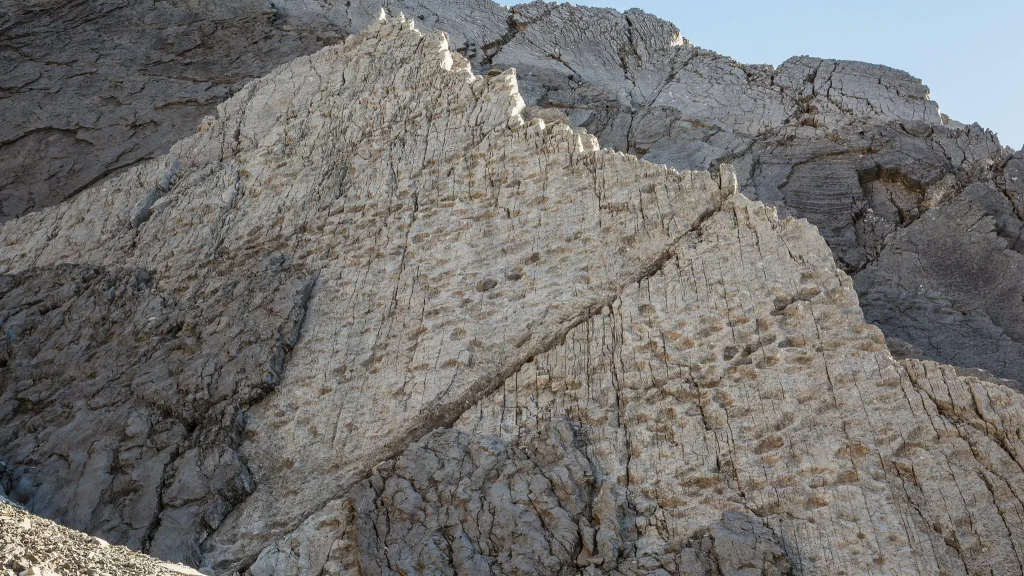
The tracks may be seen here clearly on the rock face which appears to be made up of sedimentary rocks. Now one would expect sedimentary rocks to be laid down in horizontal, parallel layers as may be seen for example in the walls of the Grand Canyon.
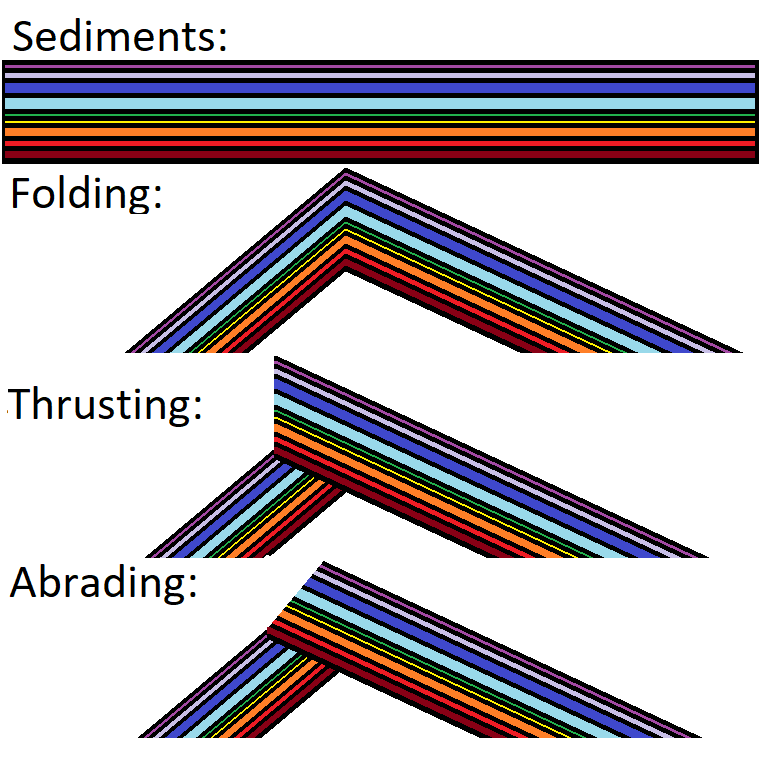
Soft material is laid down by water and over the years it hardens, and further layers are deposited on top, which themselves then harden. Coco understands that the traditional explanation for sedimentary layers that are not found in horizontal layers is that the rock layers have been folded by some later folding event, perhaps the movement together of tectonic plates, or an uplifting event such as gave rise to the great mountain ranges and in particular to the Alps in which these footprints have been found, followed by abrasion.
The prevalence of cracking in the sediments may give an indication of the plasticity or otherwise of the rocks at the time of the folding event. Cracks are visible in the photograph. Are these cracks subsequent to the folding, and due to more recent weathering, or are they original?
We should consider what happened to the sediments that would have been attached to the sediments that we can now see in the mountains. Where are they? Before the folding event they would have been at one. It is said that they may have been scoured away by other events occurring after the folding, as poorly illustrated in the diagramme.
Is that what we see here? An event has occurred which lifted the sediments; a subsequent event took away part of the rock and left the edges of sedimentary layers exposed; some time later the prosauropods came skipping along to left their footprints in the now exposed layers of sedimentary rock. Does that sound a possibility, or is it another just-so story so beloved by the old agers?
We must consider that when the tracks were left, this exposed surface, however it came to be exposed, must have been soft, at least plastic, in order that footfall would leave footprints. If the sediments had been laid down over long ages, then would they have been even remotely in a condition which we could call plastic when our dear sauropods visited it? Perhaps the absence or otherwise of cracking would provide us with a clue.
What however is fairly clear is that these are not footprints left in a sandy beach (or even a muddy on, as shown in the video, of “Footage supplied by the team of scientists [to] show the scale of the footprints and a recreation of how they were formed”. Sandy beaches, as we observe, lose their evidence of the crossing of large mammals and reptiles at almost every tide. Perhaps on a windy sandy beach they may even be lost to sight before the tide arrives. And yes, Coco is aware that sauropods may have been reptiles not mammals, but as a living one has not been able to be examined in the modern era the hypotheses that they were reptiles is perhaps no better than the hypothesis that they were mammals, unless you believe the just-so stories about footprints on a sandy beach being fossilised.
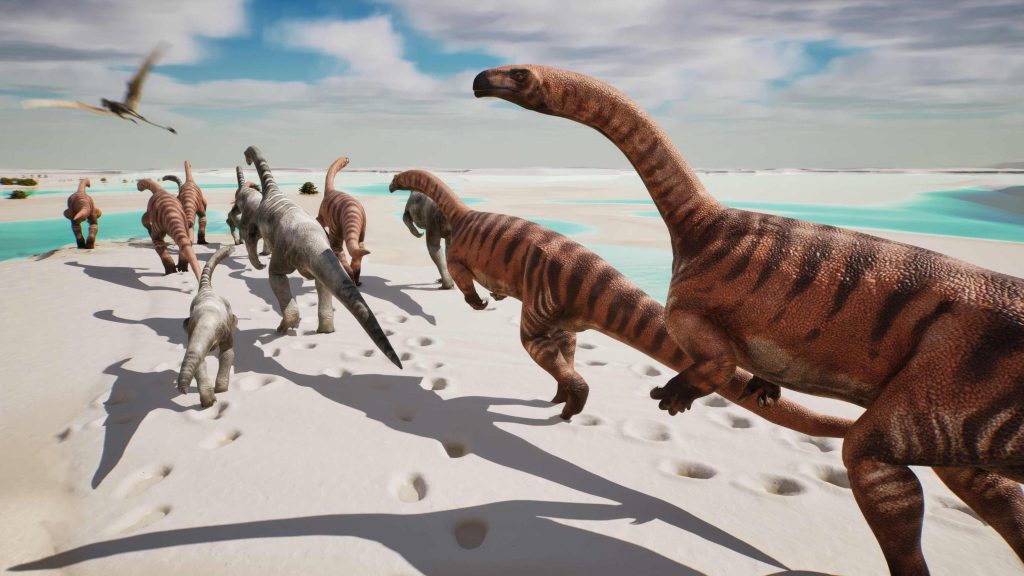
Artist’s rendition of a herd of prosauropods walking across a muddy plain during low tide. Smaller footprints suggest the herd also included young specimens
All of that said, and whilst he does not believe the story provided, Coco still cannot tell you how the footprints actually came to be embedded in the rocks now exposed in the Alps. As Holmes was supposed to have said: Once you have eliminated the possible, the only explanation left is the impossible. There was a flood. The sediments were laid down, folded and abraded quickly, and were still soft when our sauropod pod arrived.